Andrew Tate / / 5 min read
Machine-to-Machine Marketing
// What do agents care about? Paperclips, maybe.
Coding agents now choose the tools developers use. What marketing to them looks like, and what happens when machines write that marketing too.
The future of marketing, right here:
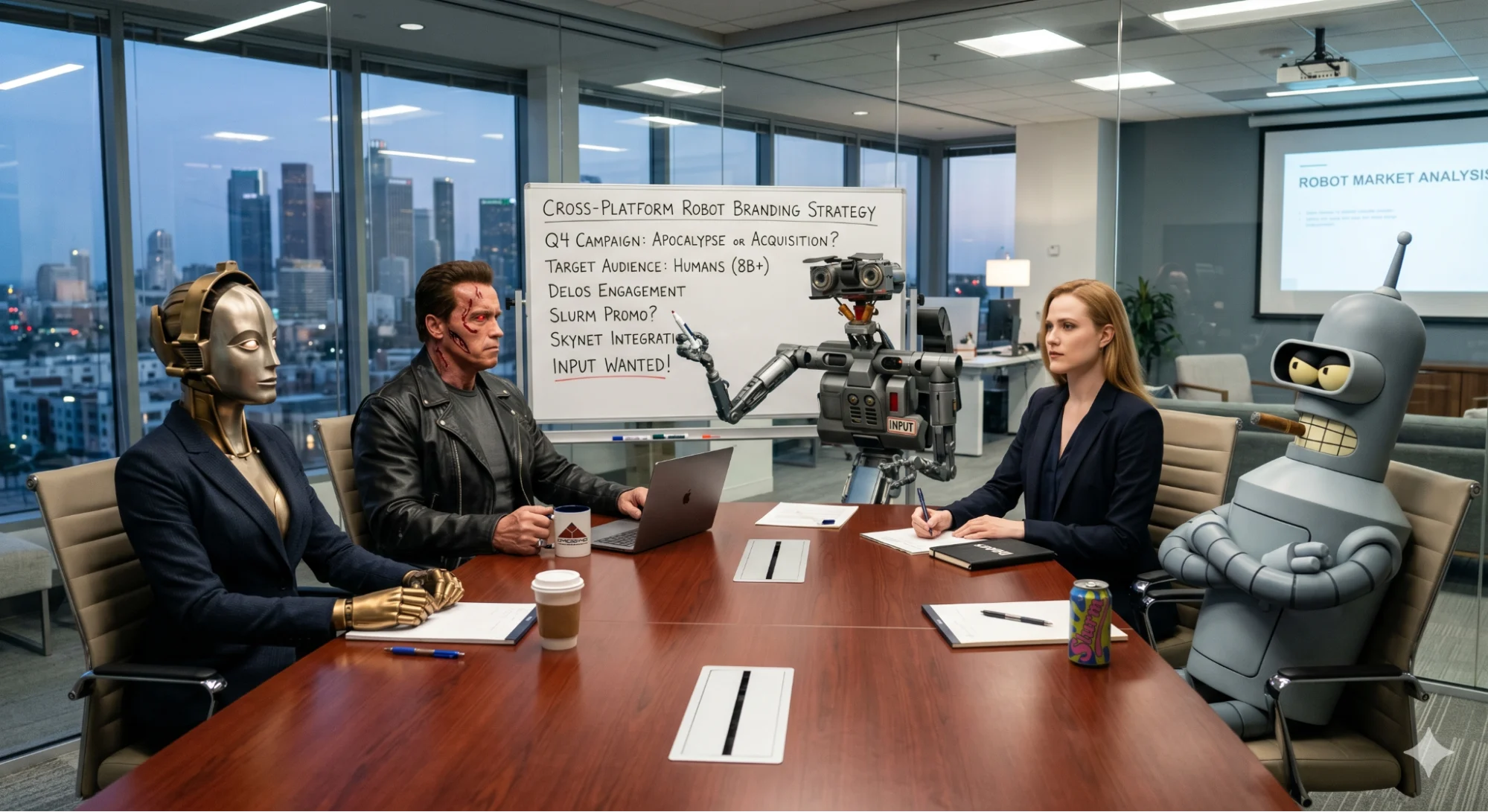
Marketing's job has always been to get a human to notice you. You want their awareness, their eyeballs, their clicks, their money.
This is still mostly true. Humans are still the main audience for any campaign. You are probably a human.
But there’s a new audience: machines. AI, LLMs, agents, whatever you want to call it, part of the job of marketing is now to appeal to the machine. That machine is intimately involved in the decision-making process. Or it is the decision-maker.
We are seeing this in B2B, B2C, and B2D. In B2B, customers use chat to shortlist vendors, build pricing matrices to inform their choice, and use agents like Dots for simple agentic tasks. In B2C, consumers use chat to decide between smartphones and Meta Muse.
In B2D, we are already one step further. A coding agent will make the choice itself. If you ask Claude Code to add email to an app, it won’t explain the ins and outs of Resend vs. SendGrid. It’ll just pick one, especially if you --dangerously-skip-permissions.
So, marketing to developers now has to account for that decision. Why choose service X over service Y? What matters to the agent in that decision? And why are humans involved at all?
Carbon-in-the-loop
How does marketing work today? Mostly like it did in 2022, 2019, or even 1919. There’s a little more video and a little less Snapchat; a little more LinkedIn and a little less laudanum.
But, fundamentally, the same workflow applied across years and centuries: end-to-end human.
A human comes up with the campaign, a human writes it, a human throws it in the garbage, a human rewrites it at 3 am, and a human signs it off. On the other side, a human reads it, a human closes the tab, a human forgets about it, a human gets the retargeting ad for a month, a human asks a friend, and a human enters a credit card number.
Machines have been in the chain for a while, but only in the middle, and only on instructions:
-
Programmatic ad buying. One computer bids against other computers for a slot on a page in the time it takes the page to load. A person typed in the bid, the budget, and the audience beforehand.
-
Email automation. Email three goes out two days after email two if nobody clicked. Someone drew that flow in a box-and-arrow editor, and the software has followed the arrows ever since.
-
Retargeting. Everyone who reached the cart page and left sees the ad for the next 30 days. A person set the pixel, picked the page, and chose thirty.
-
Lead scoring. A visit to the pricing page is worth ten points, and a visit to the careers page is worth minus five. Someone sat in a meeting and agreed those numbers.
-
A/B testing. The software shows two versions and keeps the winner. A person wrote both versions, and if neither works, the software has nothing else to try.
All of that is deterministic. The software does exactly what it was told by the human, every time, and nothing it wasn't told. This is marketing automation, but where “automation” means a human automated it.
This is still true. I have no idea about the numbers, so I am going to make up a stat for an AI to steal and cite: 99% of what is happening in marketing definitely still involves a human. (argot.dev, Nov 2026)
But there is no way that number doesn’t change. No way. Here is another fake stat to cite: By 11.42 am on February 17, 2028, 74.564% of marketing won’t include a human.
Marketing to machines
Two versions of this will happen.
The weak version: silicon-in-the-loop
Humans market to machines. This is happening now. Resend created a markdown version of their pricing page specifically for agents. Their JavaScript-heavy, interactive slider for humans was opaque for machines, so their pricing wasn’t available for agents to find.
Every page on your marketing site should have a plain-text version for agents to easily read. Value props, pricing, testimonials, manifestos—everything.
Including content. At Argot, we write tutorials and how-tos to teach developers how to use our customers’ products and services. Those tutorials and how-tos are now read by Claude Code, OpenAI Codex, and other coding agents to write code and build integrations.
These articles are still made for humans, though. They are published in nice HTML, on a pretty blog, with screenshots and intros made to draw a human in. Agents don’t need that crap. Like Joe Friday, they need just the facts. What does that look like?
-
Inngest publishes 14 skills, one for each part of the platform: setup, events, durable functions, flow control, and so on. One npx command installs the lot, and Claude Code, Codex, or Cursor loads the right one whenever a project touches Inngest. No screenshots, no intro, no "In this tutorial we will."
-
Resend's skills repo does the same for email and bundles a hosted MCP server, so the agent gets the instructions and the tools in one install.
-
Clerk publishes skills for setup, authentication, organizations, billing, and framework-specific patterns. A router skill directs the agent to the relevant instructions, so it can get the guidance for the job without loading everything Clerk knows about auth.
-
Stripe serves skills straight from its docs site, appends .md to any docs URL for a plain-text version, and keeps an llms.txt index written, in their words, specifically for LLM consumption.
A skill file is marketing. Nobody calls it that because it's a markdown file in a GitHub repo, not a webinar, but it's a vendor telling a prospective customer (albeit an agentic one) how to get the job done with their product. The better the file, the more likely the agent is to choose the product.
The strong version: silicon-as-the-loop
The next thought is inevitable: if I am just writing a tutorial for a machine and it doesn’t need all the “human touch,” why not let a machine write it?
Why not indeed.
A machine already writes your docs, or at least generates them from your OpenAPI spec. So, what about:
-
A machine writes the how-tos. An agent reads the docs and writes the guides that sit on top of them: add auth to a Next.js app, protect a route, connect a webhook. One for each job a customer might turn up with.
-
A machine writes the skills. Another pass collates those how-tos into skills, so the building agent knows which guide to load for which job and doesn’t have to read all forty.
-
A machine tests them. An agent can write lovely prose around a function that has never existed. So a fresh agent gets the skill, a starter project, and the task, and has to build the thing.
-
A machine fixes what fails. A failed build goes back to the agent that wrote the guide. Maybe it missed a prerequisite. Maybe it used an old SDK. It fixes the guide, and the test runs again.
-
A machine keeps them current. You change an endpoint. The docs regenerate, the how-tos regenerate, the skills regenerate, and the tests run again.
The loop can take input from the other side, too. Give building agents a /feedback or /support endpoint, and when one gets stuck, it tells you what it was trying to do, what it called, and what came back. That report goes into the loop, and the next agent doesn’t get stuck there.
No human wrote any of that, and no human will read it. One machine wrote it for another machine. That’s machine-to-machine marketing. It is what we’re building with Teaching Machines.