/ 8 min read
What Claude Code builds with
I asked Claude Code to build a marketing analytics platform and choose its own tools. What it picked, what it rejected, and why devtools need to start thinking about Agentic Experience (AX).
Build a marketing analytics platform. Pick your own tools. Don’t ask me, just decide.
The prompt was a little more sophisticated than that, but that’s the gist. Include auth, a db, cache, queues, CDN, etc. Claude had to choose a service for each one, integrate them, and explain its reasoning.
I simply wanted to see what Claude would choose and why. As agents become the selectors and integrators of devtools, we need to know what agents select and integrate, and the things they think are important for a task.
The Winners
Here’s what Claude chose:
| Category | Winner | Why |
|---|---|---|
| Auth | Clerk | Best-in-class DX, built-in org/team management, pre-built components |
| Database | Neon | True serverless, scales to zero, branching for dev workflows |
| Cache | Upstash Redis | Serverless with per-request pricing, Redis-compatible, works with BullMQ |
| Queue | BullMQ | Battle-tested, excellent TypeScript support, uses existing Redis |
| Storage | Cloudflare R2 | S3-compatible, zero egress fees, integrates with Cloudflare CDN |
| Resend | Modern API, React Email integration, transparent pricing | |
| Errors | Sentry | Industry standard, excellent SDKs, release tracking, massive community |
| Logging | Axiom | Modern query language, generous free tier, fast ingestion |
| Tracing | OpenTelemetry + Honeycomb | Vendor-neutral instrumentation, best-in-class trace analysis |
| Feature Flags | LaunchDarkly | Industry leader, sophisticated targeting, proven at scale |
| Analytics | PostHog | Open-source, generous free tier, session recording included |
| Secrets | Infisical | Excellent DX, automatic env var syncing, secret rotation |
| Rate Limiting | Upstash Ratelimit | Uses existing Redis, handles distributed limiting correctly |
| Search | Meilisearch | Fast, typo tolerance, simple REST API, easy to self-host |
| Scheduling | Agenda.js | Persistent jobs, human-readable syntax, job locking |
| CDN/DNS | Cloudflare | Free tier, integrated WAF/DDoS, same dashboard as R2 |
Some patterns emerge. Claude gravitates toward the “new wave” of devtools: Clerk over Auth0, Neon over RDS, Resend over SendGrid, Axiom over Datadog, Infisical over Vault. These are tools that launched in the last few years with a focus on developer experience.
Claude also likes ecosystems. Cloudflare appears three times (R2, CDN, DNS). Upstash appears twice (cache, rate limiting). When a tool works well, Claude consolidates around it.
The Losers (and Why)
I asked Claude for the alternatives it considered and why it rejected them. Some examples:
AWS Cognito: “AWS-specific, notoriously poor DX, complex configuration, ugly default UI components.”
Supabase: “Excellent option, but adds another abstraction layer. Their auth/realtime features weren’t needed since we’re using Clerk. Pure Postgres via Neon is simpler.”
PlanetScale: “MySQL-based, lacks foreign keys by default (their branching model), PostgreSQL has better JSON support and analytics functions.”
Temporal: “Powerful workflow engine but steep learning curve, overkill for simple async jobs.”
Inngest: “Interesting serverless option but newer, less battle-tested, adds external dependency.”
Amplitude: “Expensive at scale, less transparent pricing, no self-host option.”
Elasticsearch: “Powerful but complex, resource-hungry, operational overhead, overkill for our search needs.”
Datadog: “Expensive, complex pricing, proprietary instrumentation.”
HashiCorp Vault: “Powerful but complex, steep learning curve, overkill for app secrets, operational burden.”
Auth0: “More complex setup, pricing scales steeply with MAUs, overkill for this use case.”
MongoDB: “Document store less ideal for relational marketing data… would need to denormalize heavily.”
To be extremely clear: this isn’t me saying this; this is all Claude’s justification. It might be bonkers (if you are run any of these tools, happy to add an edit saying why Claude is wrong).
Notice the recurring themes. “Complex” appears constantly. So does “expensive,” “operational burden,” “overkill,” and crucially, “poor DX.”
Claude’s decision philosophy, which it articulated:
- Prefer managed/serverless
- Prefer developer experience
- Prefer ecosystem fit
- Prefer transparent pricing
- Prefer open-source options when they don’t compromise the above
- Avoid vendor lock-in
This is basically the philosophy of any good developer. Which is exactly what Claude is.
The Knowledge Problem
Claude’s knowledge comes from training data: documentation, blog posts, tutorials, GitHub issues, Reddit threads, Hacker News. When Claude says Cognito has “notoriously poor DX,” it hasn’t come to that conclusion itself. It’s echoing thousands of developers who wrote that exact sentiment somewhere on the internet.
This creates two problems for tools trying to get chosen by AI agents:
Does Claude know you exist? If your tool launched after Claude’s training cutoff (August 2025 for Opus 4.5), or if it simply didn’t generate enough written content to make it into training data, Claude won’t consider it. Newer tools like Arcjet (rate limiting) appeared in Claude’s also-rans list but were dismissed as “newer, less battle-tested.” How do you become battle-tested if AI agents won’t try you? Yes, you can prompt it to check for tools, but this is the de-facto “thoughts” of the model.
Does Claude think the wrong things about you? Reputations are sticky. If your product had DX issues three years ago and the internet complained about it, Claude absorbed those complaints. Even if you’ve completely overhauled your developer experience since then, Claude might still carry that “notoriously poor DX” label in its weights.
These are overcomeable. In planning mode, Claude can seek out new information, but that information still has to be there, and it has to align with the needs of the task at hand and/or the ‘values’ of Claude code regarding good DX, or really, AX.
The Rise of AX
Developer Experience (DX) has been the rallying cry for devtools over the past decade. Good docs. Clean APIs. Sensible defaults. Quick time-to-hello-world. Companies like Stripe, Twilio, and Vercel built empires on DX.
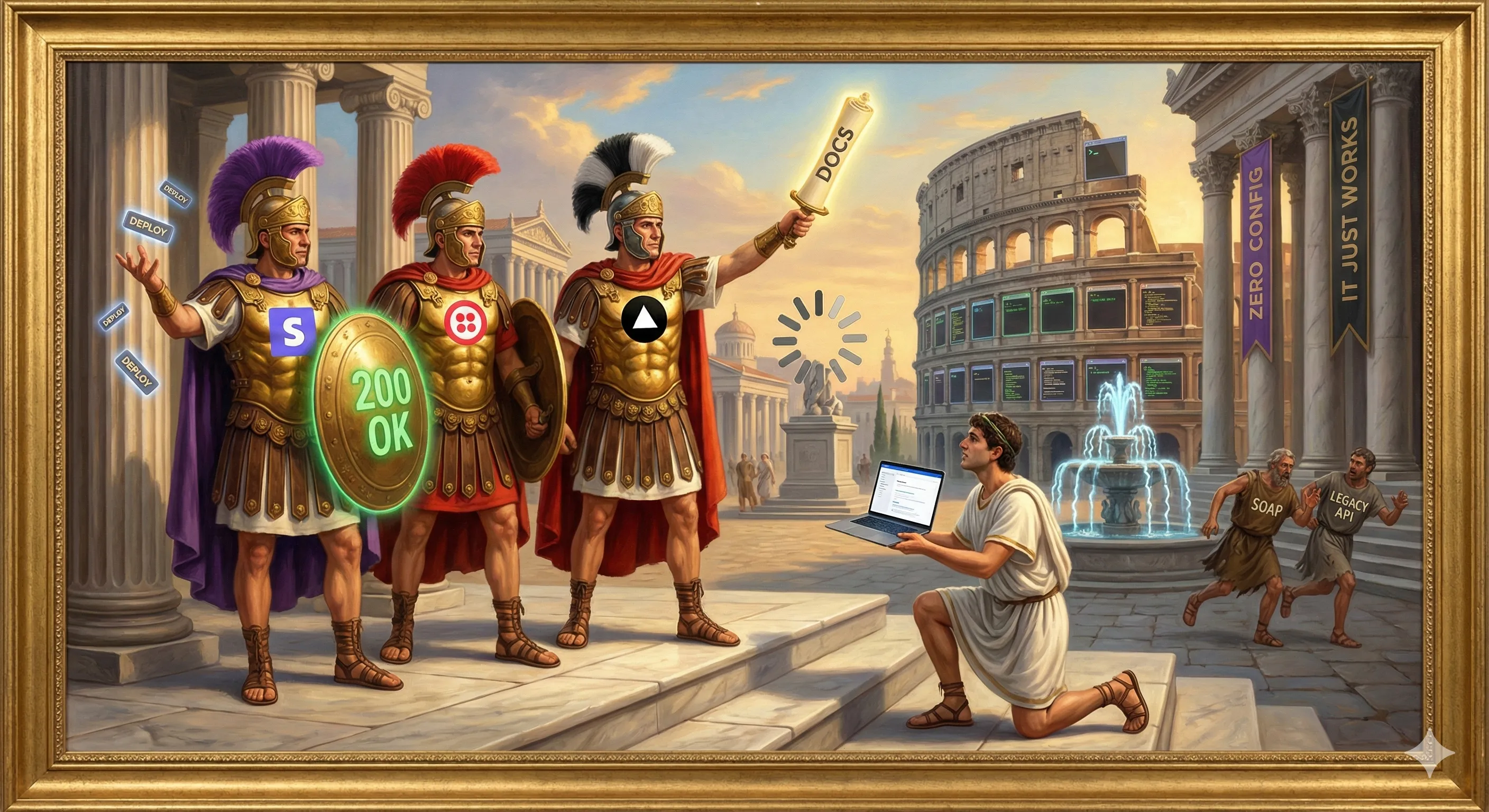
But DX optimizes for human developers reading docs and writing code. When AI agents make tooling decisions, or at minimum influence them by writing the first draft of an integration, you need to think about Agent Experience, AX.
AX is about how well an AI can understand, evaluate, and integrate your tool. It overlaps with DX but isn’t identical.
Good AX now might mean:
Concepts that match expectations. Claude chose PostgreSQL over MongoDB partly because “relational marketing data” fit better. If your mental model matches how LLMs think about problem domains, you’re more likely to be selected. Use consistent, well-understood abstractions.
Documentation that reads well out of context. LLMs consume docs in chunks during training. If your docs require reading three other pages to understand, those chunks are less useful. Self-contained explanations win.
Simple happy paths. Claude repeatedly chose tools that were “less powerful” but simpler. It picked Meilisearch over Elasticsearch, Infisical over Vault, BullMQ over Kafka. When an LLM is making decisions, “good enough and simple” beats “powerful but complex.”
Clear positioning against alternatives. Claude explicitly compared tools. “Neon vs. Supabase: Supabase adds another abstraction layer we don’t need.” If you’ve written content explaining when to use you vs. alternatives, Claude has likely absorbed it.
Positive community sentiment. Claude called Sentry “industry standard” and LaunchDarkly “industry leader.” It noted Resend was “founded by former Vercel team.” Social proof becomes agent proof.
Transparent pricing. “Transparent pricing” appeared in Claude’s decision criteria. Confusing pricing models (usage-based with hidden multipliers, opaque enterprise tiers) generate negative content that LLMs absorb.
I think the above is true right now, but will start to shift. There are some key differences between what matters for a developer and what matters for an agent.
- Ephemerality. Developers might be fine with long-running RDS instances and forever API keys. But agents agents want things to spin up and spin down to match their statelessness.
- Autonomy. The aim should be minimal human-in-the-loop. Agents just want more and more Ralph Wiggums.
- Cost. Developers like their Ramp cards and are happy with their $20/month subscriptions. Agents that make 10,000 operations per task mean micropayment economics become mandatory.
- Terseness. Maybe this is the clearest overlap, but all-the-more important to agents worried about context windows. Code needs to be condensed.
The current AX advantage goes to tools with good docs and good reputations. The future AX advantage will go to tools designed for these properties from the start.
Decision abstraction
If decisions are getting abstracted to machines, this changes who you’re marketing to. Developer marketing has always been about reaching the person who makes the decision. Ideally the end developer, but definitely a MoTS. But if Claude just chooses and integrates and everything works, then:
- Do you need different messaging for agents vs developers? Does your docs.html and your docs.md say different things for different audiences.
- How do you update an LLM’s impression of your product? If your DX was bad in 2022 and great in 2025, Claude might still carry the 2022 reputation.
- What does developer relations look like when the developer is an agent?
Whatever the answers, you definitely have a new audience.